 When a patient comes to our physical therapy clinic with lower back pain it is standard protocol to take a thorough history and complete a neurological exam. This is especially important if the patient has leg pain, tingling or numbness in one or both legs referred from their lower back. During the history, the patient will often reports an increase in symptoms in their legs at night in bed. They report pain, tingling, a need to constantly move their legs. While some of these symptoms are associated with lower back pain and “sciatica” others, such as the urge to constantly move the legs, is not. This may be a symptom associated with another problem such as restless legs syndrome or RLS.
Recently, more information has become available on restless legs syndrome (RLS).
According to the RLS Foundation, RLS is a neurological condition suffered by approximately 10% of the population in the United States. It is considered a central nervous system disorder. There are many manifestations of this disease. Some people suffer only mild symptoms creating urges to move their legs in bed at night. Others suffer severe symptoms of uncontrollable urges to move their legs sitting or lying. The problem may lead to insomnia, disrupted sleep, distress and fatigue. Two main types of RLS have been identified. One is genetic among first-degree relatives. This type develops earlier in life and the symptoms are more severe. There is also an iron deficiency associated with genetic RLS. The other type is non-inherited or idiopathic. This type is more associated with aging. There are several criteria to diagnose RLS. Also, there are medications and other treatment options available for RLS. Exercise, including stretching, walking and weight-training can be very effective.
The RLS Foundation Has 4 Criteria for Diagnosis of RLS:
Medication – 2 FDA- Approved Dopaminergic Agents:
Behavioral Management
Sources: RLS Foundation, Rochester, MN & Today in PT
Read Dr. Mackarey’s Health & Exercise Forum – every Monday in the Scranton Times-Tribune.
This article is not intended as a substitute for medical treatment. If you have questions related to your medical condition, please contact your family physician. For further inquires related to this topic email: drpmackarey@msn.com
Paul J. Mackarey PT, DHSc, OCS is a Doctor in Health Sciences specializing in orthopaedic and sports physical therapy. Dr. Mackarey is in private practice and is an associate professor of clinical medicine at The Commonwealth Medical College.

David Louis
Guest Author: David Louis
Guest columnist David Louis is a third-year medical student at The Commonwealth Medical College in Scranton.
Reflections of a Medical Student
The first day of my medicine rotation, I proudly put on my white coat and stuffed its pockets with my stethoscope, reflex hammer, otoscope and a few pocket-sized books to help get me through the day. The stress and anxiety of taking Step 1 was over. I was going to treat patients! Heal the sick. Comfort those in mourning. I was finally where I wanted to be: in the hospital.
When I arrived, weighed down by the multitude of objects in my white coat, I was greeted by, “go down to the ICU and see T.E., a 40-year-old woman in septic shock and respiratory failure secondary to an abdominal surgery.” With that single sentence I was brought back to reality, and the realization set in: maybe I was not as prepared as I had thought.
As I walked into her ICU suite, prepared to attain as much information as I could from her, I discovered to my dismay that she was intubated and on a ventilator. The standard third-year history and physical I had memorized was going to need some tweaking.
Over the next coming week, we had formed a bond. I spent time with her and her family, pointing at posters showing the letters of the alphabet, or pictures of nouns and verbs, in an attempt to construct the sentences. On some visits I would spend close to an hour in her room, attempting to form her sentences, letter-by-letter, word-by-word.
By midweek, I had formed a routine of rounding on my patients, with T.E being the last. On that Thursday, I walked by her room on my way to the computer station. To my surprise, she had been extubated — taken off the ventilator! I stopped in my tracks, turned to her and her family, and threw up my arms yelling, “You can talk!”
In retrospect, this story represents the reason why I have chosen a career in medicine. No amount of studying a disease process or treatment modalities would have prepared me for this experience. I have found that most physicians who are able create a tight-knit bond with their patients all express the same trait: vulnerability.
Ask yourself: do I allow myself to lay my emotions, fears and thoughts out on the table when interacting with my patients? Do they know I’m terrified right now? What if I make a mistake, make the wrong diagnosis or prescribe the wrong medicine? Medical students and physicians early in their careers are exceptionally vulnerable. We are still learning how to take a history and physical and form a treatment plan. Something as simple as starting IV fluids has the potential to either seriously harm or help a patient. And we know this. This is the reason why we overthink our treatment plan, or begin stuttering when an attending asks us what our plan is. I believe that by showing our vulnerability and acceptance of failure will allow physicians of all ages to improve their practice of medicine.
Vulnerability does not simply apply to tangible medicine either. My experience with T.E was successful only because I walked into her room eager to face a new experience and content with the risk of failure. It is what most medical students face day-after-day. Unfortunately, we do not always realize it. I am writing this short essay to bright to light the power and value of vulnerability and the positive impact it can have on your life and the life of your patients. Do not fear failure. Accept the knowledge that you will fail and be willing to learn from the experience. But I will add a disclaimer: do not make the same mistake twice.
In this regard, there is no career like medicine. We have the capacity to form such meaningful relationships with those in need. Information that not even their closest friends or family members know about, is shared with us. Clearly, patients allow themselves to be vulnerable. Let us create a movement in which physicians reciprocate that feeling. All too often I seen the physician-patient relationship as one sided. It is time for that to change. And it can change! Letter-by-letter, word-by-word, we have the power to display our vulnerability and improve patient care. I certainly would not have realized this if it were not for T.E.
Source: https://pamedicalsociety.wordpress.com/2015/04/22/the-joys-and-fears-of-displaying-our-vulnerability/
Read Dr. Mackarey’s Health & Exercise Forum – Every Monday in the Scranton Times-Tribune
This article is not intended as a substitute for medical treatment. If you have questions related to your medical condition, please contact your family physician. For further inquires related to this topic email: drpmackarey@msn.com
Paul J. Mackarey PT, DHSc, OCS is a Doctor in Health Sciences specializing in orthopaedic and sports physical therapy. Dr. Mackarey is in private practice and is an associate professor of clinical medicine at The Commonwealth Medical College.
Read Dr. Mackarey’s Health & Exercise Forum – Every Monday in the Scranton Times-Tribune.
In a few short weeks, organized high school fall preseason practices will begin. This includes; football, soccer, cheerleading, women’s tennis, etc. Unfortunately, after a long break from participating in many of these activities, even young athletes are vulnerable to a variety of injuries, including a pulled muscle on the inside of the thigh called a groin strain. Groin strains are common in the pre and early season but with a few additions to an exercise and training program, prevention is possible.
A groin strain is a tear of the muscle fibers of the groin muscle. The groin muscle is group of muscles (adductor muscles) that run from the hip (inner pelvis) and attach to the thigh bone (femur). The adductor muscles work to stabilize the hip during weight bearing activities, such as running. They are very active when an athlete changes direction, especially side to side such as guarding an opponent with a defensive slide. This injury, like others, varies in intensity. Severe groin strain occurs when many muscle fibers are torn. In very severe cases, the boney attachment can be pulled so strongly that a small fracture can occur. Healing time can be as short as a few days or as long as weeks or even months.
Your family physician will examine your hip and groin to determine if you have groin strain. In more advanced cases you may be referred to an orthopedic surgeon for further examination and treatment. An X-ray, MRI or bone scan will show the extent of the tear and if the bone is involved. The diagnosis will determine if you problem if minor, moderate or severe.
There are many conservative options. You and your family physician or orthopedic surgeon will decide which choices are best.
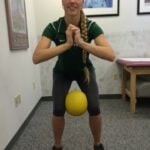
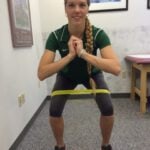
SOURCES: Journal of Physical Medicine & Rehabilitation and American Academy of Orthopaedic Surgeons
MODEL: Katherine Weaver
Visit your doctor regularly and listen to your body.
NEXT MONDAY – Read Dr. Paul J. Mackarey “Health & Exercise Forum” in the Scranton Times-Tribune.
This article is not intended as a substitute for medical treatment. If you have questions related to your medical condition, please contact your family physician. For further inquires related to this topic email: drpmackarey@msn.com
Paul J. Mackarey PT, DHSc, OCS is a Doctor in Health Sciences specializing in orthopaedic and sports physical therapy. Dr. Mackarey is in private practice and is an associate professor of clinical medicine at The Commonwealth Medial College.
Swimmer's Shoulder: Part 2 of 2
Last week, guest columnist, Dr. Gary Mattingly, anatomy professor at the University of Scranton, described the problem of “swimmer’s shoulder” … “inflammation of part of the rotator cuff, a group of muscles that stabilize the shoulder passes between the arm bone (humerus) and a bone in the back (scapula). Due to a swimmer’s stroke or the overuse of the rotator cuff with constant lap swimming, the rotator cuff gets repetitively pinched between the two bones. This produces a painful inflammatory condition known as swimmer's shoulder.” Poor swim stroke mechanics and technique contributes to the problem.
Impingement in the swimmer’s shoulder can occur during the pull-through phase of freestyle. The problem is more likely to occur in this phase if poor technique allows the hand to cross mid-line of the body. Impingement can also occur during the recovery phase of the freestyle and is more common when the rotator cuff muscles are fatigued and inefficient. Lastly, impingement can occur from overuse or overtraining. A competitive swimmer may perform 20,000 strokes per week which may result in inflammation and swelling. The increased swelling of the tendons make them more vulnerable to impingement in the small space between the shoulder bones.
These three types of impingement can be related. Overtraining can lead to shoulder pain if the swimmer continues to swim with fatigued muscles. As the muscles fatigue they will work less efficiently which has two poor consequences. First, the muscles will have to work harder in a weakened condition. Second, the swimmer will have to perform more strokes to cover the same distance, which is overusing already fatigued muscles. Together these factors can result in swimmer's shoulder.
Swimmer's shoulder can be prevented by using proper freestyle stroke. The hand should enter the water with the small finger first and the palm facing inward. When the hand enters the water it should not cross the middle of the body to avoid impingement. For further stroke instruction, seek the advice of a swimming coach.
Swimmers should avoid rapid increases in training distances or frequency of training as this is likely to wear out the shoulder muscles leaving them at risk for impingement and shoulder pain.
Swimmers have a tendency to develop “swimmer’s posture.” Swimmers have tight neck, chest and anterior shoulder muscles that cause them to assume a hunched over posture. This poor posture decreases the distance between the humerus and scapula making the shoulder more prone to impingement. Good posture with head and shoulders back increases the distance between the humerus and scapula. Therefore good posture is a good treatment for swimmer’s shoulder because it decreases the impingement. To address posture concerns, stretching shoulder, chest and neck muscles will help to prevent a swimming posture.
The Nicholas Institute of Sports Medicine and Athletic Trauma suggest the following stretches to prevent swimmer’s shoulder:
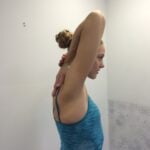
Triceps stretch: Raise your arm directly over your head. Bend your elbow and try to reach the shoulder blade on the same side of you body. Use your opposite arm to push your elbow back. Feel the stretch behind your elbow. (See PHOTO 1)
Pectoralis Stretch: Place both elbows against the frame of a door or in a corner of a room. Keep the angle between your trunk and your arm at 90 degrees. Rest your forearms against the door frame or corner wall. Lean forward to feel the stretch across your chest. Doorway Stretch (See PHOTO 2) and Corner Stretch (See PHOTO 3)
Infraspinatus stretch: Extend your arm out directly in front of you and bend your elbow across your body. With your other hand gently pull your elbow across your body. Feel the stretch behind your shoulder and shoulder blade. (See PHOTO 4)
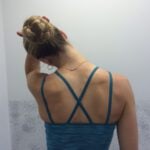
Levator scapulae stretch: To stretch the right side: Look towards your opposite (left) hip and place the right hand behind your back. Use the left hand on to gently stretch your head/nose towards your left hip. (See PHOTO 5)
Upper trapezius stretch: To stretch the right side: Tilt your head to the left side and try to bring your ear towards the left shoulder without lifting the right shoulder. Use the left hand to gently stretch the head toward the left shoulder. (See PHOTO 6)
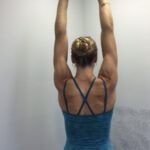
Latissimus dorsi stretch: Raise both arms overhead and place palms together interlocking fingers. At shoulders lift arms upwards with fingers remaining intertwined. (See PHOTO 7)
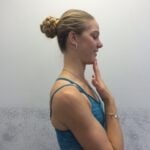
Axial extension: Pull your chin down and backwards as if trying to make a double chin. (See PHOTO 8)
Keep in mind that avoiding bad posture in your day to day activities can help swimmer’s shoulder and remember “Sit up straight!”
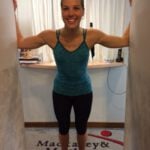
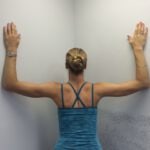
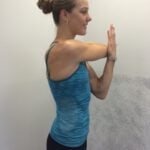
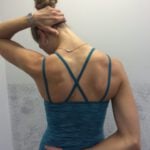
GUEST COLUMNIST: Gary Mattingly, PT, PhD. Dr. Mattingly is a professor of anatomy at the University of Scranton, Department of Physical Therapy.
MODEL: Katherine Weaver, Assist. Men’s and Women’s Swim Coach at Marywood University and Physical Therapy Aid at Mackarey Physical Therapy.
Visit your doctor regularly and listen to your body.
NEXT MONDAY – Read Dr. Paul J. Mackarey “Health & Exercise Forum” in the Scranton Times-Tribune.
This article is not intended as a substitute for medical treatment. If you have questions related to your medical condition, please contact your family physician. For further inquires related to this topic email: drpmackarey@msn.com.
Paul J. Mackarey PT, DHSc, OCS is a Doctor in Health Sciences specializing in orthopaedic and sports physical therapy. Dr. Mackarey is in private practice and is an associate professor in clinical medicine at The Commonwealth Medical College.
It’s summer time! 4th of July weekend is a great time to enjoy the water. Whether your swimming laps for exercise or competition, be careful not to overdo it and injure your shoulder. While there are many different types of shoulder problems, one is specific to the sport of swimming called “swimmer’s shoulder”.
The shoulder is the most complex joint in the body and one that is commonly injured. Shoulder injuries can span all ages and sports. A little league player can experience shoulder pain after a game while their grandmother can experience a similar shoulder pain after working in the garden. However, it is important to keep in mind that not all shoulder pain is the same. Since the shoulder is such a complex joint, many different things can go wrong resulting in pain. A partial list of some of the most common shoulder problems follows:
It is well-known that swimmers are vulnerable to shoulder pain for many reasons. The last three shoulder problems from the above list, (impingement, tendonitis, bursitis) are the most common for a swimmer.
Swimmer’s Shoulder – occurs when part of the rotator cuff, a group of muscles that stabilize the shoulder, passes between the arm bone (humerus) and a bone in the back (scapula). Due to a swimmer’s stroke or the overuse of the rotator cuff with constant lap swimming, the rotator cuff gets repetitively pinched between the two bones. This produces a painful inflammatory condition known as swimmer's shoulder.
“Sit up straight!” While growing up we must have heard this statement thousands of times from parents and teachers and if you have kids, especially teenagers, you have probably said it a few times yourself. Interestingly, your parents may have been on to something very good if you became a competitive swimmer. New research is demonstrating that good posture may help or even prevent swimmers shoulder.
One type of pinching or impingement occurs during the pull-through phase of freestyle. The pull-through phase begins when the hand enters the water and terminates when the arm has completed pulling through the water and begins to exit the surface. At the beginning of pull-through, termed hand-entry, if a swimmer's hand enters the water across the mid-line of her body this will place the shoulder in a position which pinches part of the rotator cuff.
A second type of impingement may occur during the recovery phase of freestyle. The recovery phase is the time of the stroke cycle when the arm is exiting the water and lasts until that hand enters the water again. As a swimmer fatigues it will become more difficult for her to lift her arm out of the water, and the muscles of the rotator cuff become less efficient which can also result in impingement.
A third type of impingement may result from simple overuse or overtraining. A competitive swimmer may perform over 20,000 strokes per week. This overuse may cause the muscles and tendons of the rotator cuff to become inflamed and swell. The swelling of the muscles and tendons will make the shoulder more prone to impingement.
GUEST COLUMNIST: Gary Mattingly, PT, PhD. Dr. Mattingly is a professor of anatomy at the University of Scranton, Department of Physical Therapy.
Read Dr. Mackarey’s "Health & Exercise Forum" in the Scranton Times-Tribune every Monday. Next week: “Swimmer’s Shoulder- Part 2”
This article is not intended as a substitute for medical treatment. If you have questions related to your medical condition, please contact your family physician. For further inquires related to this topic email: drpmackarey@msn.com
Paul J. Mackarey PT, DHSc, OCS is a Doctor in Health Sciences specializing in orthopaedic and sports physical therapy. Dr. Mackarey is in private practice and is an associate professor in clinical medicine at The Commonwealth Medical College.
10th ANNIVERSARY Series of 5 Columns Celebrating Life!
Part 5 of 5
“Health and Exercise Forum” by Dr. Paul Mackarey, completes its 10TH year in June of 2015 …THANK YOU! Thank you for your kind words, positive (and negative) feedback in the form of phone calls, texts, emails and simple chats on the streets. I am grateful and humbled. In honor of the 10th anniversary of “Health and Exercise Forum,” I decided to write a series of columns that encapsulates the most important messages regarding health and wellness, base on current wisdom. Readers in NEPA seem to be consistently interested in is health, wellness and longevity. While I have written about this repeatedly, in many different ways, over the past 10 years, I thought this would be the perfect time to share some new information. Please enjoy and embrace the wisdom of those centenarians both from NEPA and from around the globe and let me know your thoughts.
BLUE ZONES
Academics have long suspected that there are specific clusters of people around the globe who significantly outlive the general population. This concept provoked National Geographic Explorer Dan Buettner, to travel around the world in an attempt to study geographic locations around the world that had the greatest concentration of centenarians. He and his research team further studied their cultures and social habits to determine commonalities among these people and their habitats. He discovered that DNA is only one of many ingredients for a long and healthy life. His book, The Blue Zone, details his findings and here is a summary of what they found…
Buettner and his team identified five specific locations on the planet where people seem to have found the “secrets of a long life:” Sardinia, Italy; Okinawa, Japan; Nicoya, Costa Rica; Ikaria, Greece; Loma Linda, California. But, Buettner and his team were not just impressed with the age of the people they met in these zones, but the active lifestyle they maintained, even at 102 years of age. For example, he met a 94 year old man from Costa Rica, who continues to work as a farmer and a 102 year old woman from Sardinia, who hikes at least 6 miles every day. He designated these “Blue Zones” as special places where several common traits contributed to longevity; strong social structure, plant-based diet, moderate consumption of food and daily physical activity. Researchers hope that with lessons learned from the “blue zones” and their people, in combination with scientific discovery, technology and modern medicine, that other people can create their own healthy spaces, change lifestyles and live longer, healthier and happier lives.
THE NINE CHARACTERISTICS OF BLUE ZONE CENTENARIANS…
From, National Geographic Explorer and New York Times best-selling author, Dan Buettner, author of , “Blue Zones” and “Power 9R,”assembled a team of medical researchers, anthropologists, demographers and epidemiologists to discover scientific support for the most common characteristics associated with a long and active life represented in all 5 blue zones. These nine common denominators are referred to as “Power 9R”and offer other people on the planet necessary information to create their own “Blue Zone,” to live longer, healthier, happier lives! This is what they discovered:
In conclusion, DNA is only part of the equation to live a long and happy life. You can create your own “Blue Zone” and exceed your life expectancy by adopting the “Power 9R” principles. Living in the stress and frenzy of the USA is not an excuse…as demonstrated by the Adventists, the average person’s life expectancy could increase by 10-12 years by adopting a Blue Zone lifestyle.
Read Dr. Mackarey’s Health & Exercise Forum in the Scranton Times-Tribune every Monday.
This article is not intended as a substitute for medical treatment. If you have questions related to your medical condition, please contact your family physician. For further inquires related to this topic email: drpmackarey@msn.com
Paul J. Mackarey PT, DHSc, OCS is a Doctor in Health Sciences specializing in orthopaedic and sports physical therapy. Dr. Mackarey is in private practice and is an associate professor of clinical medicine at The Commonwealth Medical College.
10th ANNIVERSARY Series of 5 Columns Celebrating Life! Part 4 of 5
“Health and Exercise Forum” by Dr. Paul Mackarey, completes its 10TH year in June of 2015 …THANK YOU! Thank you for your kind words, positive (and negative) feedback in the form of phone calls, texts, emails and simple chats on the streets. I am grateful and humbled. In honor of the 10th anniversary of “Health and Exercise Forum,” I decided to write a series of columns that encapsulates the most important messages regarding health and wellness, base on current wisdom. Readers in NEPA seem to be consistently interested in is health, wellness and longevity. While I have written about this repeatedly, in many different ways, over the past 10 years, I thought this would be the perfect time to share some new information. Please enjoy and embrace the wisdom of those centenarians both from NEPA and from around the globe and let me know your thoughts.
BLUE ZONES
Academics have long suspected that there are specific clusters of people around the globe who significantly outlive the general population. This concept provoked National Geographic Explorer Dan Buettner, to travel around the world in an attempt to study geographic locations around the world that had the greatest concentration of centenarians. He and his research team further studied their cultures and social habits to determine commonalities among these people and their habitats. He discovered that DNA is only one of many ingredients for a long and healthy life. His book, The Blue Zone, details his findings and here is a summary of what they found…
Buettner and his team identified five specific locations on the planet where people seem to have found the “secrets of a long life:” Sardinia, Italy; Okinawa, Japan; Nicoya, Costa Rica; Ikaria, Greece; Loma Linda, California. But, Buettner and his team were not just impressed with the age of the people they met in these zones, but the active lifestyle they maintained, even at 102 years of age. For example, he met a 94 year old man from Costa Rica, who continues to work as a farmer and a 102 year old woman from Sardinia, who hikes at least 6 miles every day. He designated these “Blue Zones” as special places where several common traits contributed to longevity; strong social structure, plant-based diet, moderate consumption of food and daily physical activity. Researchers hope that with lessons learned from the “blue zones” and their people, in combination with scientific discovery, technology and modern medicine, that other people can create their own healthy spaces, change lifestyles and live longer, healthier and happier lives.
IKARIA, GREECE
Ikaria, Greece, like other Blue Zones, is a small isolated island in the Aegean Sea southwest of the Greek island of Samos. Isolation has fostered strong traditions grounded in family values that emphasize a healthy mind, body and spirit. Inhabitants regularly enjoy the therapeutic benefits of the many natural thermal hot springs on the island. They have 20% less cancer 50% less cardiovascular disease and dementia is almost nonexistent. Locals engage in farming, fishing, and walking through the many hills and mountains on a daily basis. Their Mediterranean diet is rich in olive oil with plenty of fish, fruit, and whole grains, while goat milk and wine are consumed regularly. Each day time is set aside for relaxation in the form of a nap and visiting with family and friends.
Healthy Living in Ikaria, Greece:
LOMA LINDA, CA (PHOTO OR MAP)
Healthy Living in Loma Linda, CA:
Read Dr. Mackarey’s Health & Exercise Forum in the Scranton Times-Tribune every Monday. Next week read: Part 5 of 5 “Longevity”
This article is not intended as a substitute for medical treatment. If you have questions related to your medical condition, please contact your family physician. For further inquires related to this topic email: drpmackarey@msn.com
Paul J. Mackarey PT, DHSc, OCS is a Doctor in Health Sciences specializing in orthopaedic and sports physical therapy. Dr. Mackarey is in private practice and is an associate professor of clinical medicine at The Commonwealth Medical College.
10th ANNIVERSARY
Series of 5 Columns Celebrating Life! Part 3 of 5
“Health and Exercise Forum” by Dr. Paul Mackarey, completes its 10TH year in June of 2015 …THANK YOU! Thank you for your kind words, positive (and negative) feedback in the form of phone calls, texts, emails and simple chats on the streets. I am grateful and humbled. In honor of the 10th anniversary of “Health and Exercise Forum,” I decided to write a series of columns that encapsulates the most important messages regarding health and wellness, base on current wisdom. Readers in NEPA seem to be consistently interested in is health, wellness and longevity. While I have written about this repeatedly, in many different ways, over the past 10 years, I thought this would be the perfect time to share some new information. Please enjoy and embrace the wisdom of those centenarians both from NEPA and from around the globe and let me know your thoughts.
BLUE ZONES
Academics have long suspected that there are specific clusters of people around the globe who significantly outlive the general population. This concept provoked National Geographic Explorer Dan Buettner, to travel around the world in an attempt to study geographic locations around the world that had the greatest concentration of centenarians. He and his research team further studied their cultures and social habits to determine commonalities among these people and their habitats. He discovered that DNA is only one of many ingredients for a long and healthy life. His book, The Blue Zone, details his findings and here is a summary of what they found…
Buettner and his team identified five specific locations on the planet where people seem to have found the “secrets of a long life:” Sardinia, Italy; Okinawa, Japan; Nicoya, Costa Rica; Ikaria, Greece; Loma Linda, California. But, Buettner and his team were not just impressed with the age of the people they met in these zones, but the active lifestyle they maintained, even at 102 years of age. For example, he met a 94 year old man from Costa Rica, who continues to work as a farmer and a 102 year old woman from Sardinia, who hikes at least 6 miles every day. He designated these “Blue Zones” as special places where several common traits contributed to longevity; strong social structure, plant-based diet, moderate consumption of food and daily physical activity. Researchers hope that with lessons learned from the “blue zones” and their people, in combination with scientific discovery, technology and modern medicine, that other people can create their own healthy spaces, change lifestyles and live longer, healthier and happier lives.
OKINAWA, JAPAN
Okinawa is a small island in the Pacific Ocean 360 miles off the coast of Japan known for its beautiful beaches, turquoise waters, and temperate climate. It has long been recognized as “the land of the immortals.” However, in recent years, with outside influence and fast foods, younger generations are not enjoying the same longevity as their predecessors and parents are beginning to outlive their children. Despite these changes, Okinawa still enjoys one of the largest numbers of centenarians on the planet, with lower rates of cancer, heart disease or dementia than Americans. Okinawans practice an eating habit called “Hara Hachiu Bu” in which they purposely limit the amount of food (calories) they eat at every meal by eating only until they are 80% full. This practice is scientifically supported because it takes the stomach 20 minutes to communicate with your brain when you are full. So, by Hara Hachiu Bu you will stop eating 20 minutes sooner than you would otherwise. Okinawans also pride themselves in maintaining a fruitful garden. It is the primary source of healthy and fresh foods, some of which offer protection from diseases like malaria. Additionally, laboring in the garden keeps them strong and mobile, while the exposure to the sun produces vitamin D to keep bones strong. Lastly, much like the Sardinians, Okinawans are generally good natured and enjoy a positive outlook on life. They maintain strong ties with family and friends (moais) throughout their lives for social, emotional, and financial support.
Healthy Living in Okinawa:
NICOYA, COSTA RICA
As in many regions whose people enjoy longevity, Nicoya, Costa Rica is an isolated island. Located south of Nicaragua on the Pacific Coast, and accessible only by ferry until recently it enjoys a long tradition of peace, health and wellness. Since 1948, Costa Rica has not had an active army and is proud of it. Instead, the government shifted its emphasis on education, health and culture. In this spirit, President Oscar Arias Sanchez was the recipient of the Nobel Peace Prize in 1987 for his role in bringing peace to Central America. This pervasive national attitude, along with other admirable life-style traditions, has contributed to the health and longevity of its citizens. While Costa Rica spends only 15% of what the United States spends on healthcare, its citizens can expect a longer and healthier life than those in the USA. In fact, a man in Costa Rica is twice as likely to live to be 90 years of age, as compared to men in the USA, France or Japan. Moreover, Costa Ricans fortunate enough to live on the island of Nicoya, enjoy even greater health and longevity with the lowest cancer rates in the entire country. We can learn some valuable lessons on healthy living from the inhabitants of Nicoya.
Healthy Living in Nicoya, Costa Rica:
Read Dr. Mackarey’s Health & Exercise Forum – Every Monday in the Scranton Times-Tribune. Next week read: Part 4 of 5 “Longevity”
This article is not intended as a substitute for medical treatment. If you have questions related to your medical condition, please contact your family physician. For further inquires related to this topic email: drpmackarey@msn.com
Paul J. Mackarey PT, DHSc, OCS is a Doctor in Health Sciences specializing in orthopaedic and sports physical therapy. Dr. Mackarey is in private practice and is an associate professor of clinical medicine at The Commonwealth Medical College.
10th ANNIVERSARY : Series of 5 Columns Celebrating Life!
Part 2 of 5
“Health and Exercise Forum” by Dr. Paul Mackarey, completes its 10 year in June of 2015 …THANK YOU! Thank you for your kind words, positive (and negative) feedback in the form of phone calls, texts, emails and simple chats on the streets. I am grateful and humbled. In honor of the 10th anniversary of “Health and Exercise Forum,” I decided to write a series of columns that encapsulates the most important messages regarding health and wellness, base on current wisdom. Readers in NEPA seem to be consistently interested in is health, wellness and longevity. While I have written about this repeatedly, in many different ways, over the past 10 years, I thought this would be the perfect time to share some new information. Please enjoy and embrace the wisdom of those centenarians both from NEPA and from around the globe and let me know your thoughts.
Academics have long suspected that there are specific clusters of people around the globe who significantly outlive the general population. This concept provoked National Geographic Explorer Dan Buettner, to travel around the world in an attempt to study geographic locations around the world that had the greatest concentration of centenarians. He and his research team further studied their cultures and social habits to determine commonalities among these people and their habitats. He discovered that DNA is only one of many ingredients for a long and healthy life. His book, The Blue Zone, details his findings and here is a summary of what they found…
Buettner and his team identified five specific locations on the planet where people seem to have found the “secrets of a long life:” Sardinia, Italy; Okinawa, Japan; Nicoya, Costa Rica; Ikaria, Greece; Loma Linda, California. But, Buettner and his team were not just impressed with the age of the people they met in these zones, but the active lifestyle they maintained, even at 102 years of age. For example, he met a 94 year old man from Costa Rica, who continues to work as a farmer and a 102 year old woman from Sardinia, who hikes at least 6 miles every day. He designated these “Blue Zones” as special places where several common traits contributed to longevity; strong social structure, plant-based diet, moderate consumption of food and daily physical activity. Researchers hope that with lessons learned from the “blue zones” and their people, in combination with scientific discovery, technology and modern medicine, that other people can create their own healthy spaces, change lifestyles and live longer, healthier and happier lives.
Sardinia is a Mediterranean island located off the coast of Italy, slightly more distance than Cuba is to the US. According to the book, “Blue Zones,” there are 10 times more centenarians per 1000 people in Sardinia than in the US. The lifestyle and social traditions contribute to long-lived men in several ways. This is most unusual because women typically outlive men. The men in Sardinia work in the mountainous regions of the island as farmers or shepherds. Consequently, they walk many miles each day, up and down steep and difficult terrain, working the land and herding the flock. These are daily activities that continue throughout life, even well into the 90’s and 100. They do not retire from tasks essential to sustain life…food, shelter, etc.
Read Dr. Mackarey’s "Health & Exercise Forum" in the Scranton Times-Tribune every Monday. Next week read: Part 3 of 5, “Longevity”
This article is not intended as a substitute for medical treatment. If you have questions related to your medical condition, please contact your family physician. For further inquires related to this topic email: drpmackarey@msn.com
Paul J. Mackarey PT, DHSc, OCS is a Doctor in Health Sciences specializing in orthopaedic and sports physical therapy. Dr. Mackarey is in private practice and is an associate professor of clinical medicine at The Commonwealth Medical College.
Part 1 of 5
“Health and Exercise Forum” by Dr. Paul Mackarey, completes its 10 year in June of 2015 …THANK YOU! Thank you for your kind words, positive (and negative) feedback in the form of phone calls, texts, emails and simple chats on the street. I am grateful and humbled. As I wrote in my first column in June of 2005, “Health and Exercise Forum” is your column and has no purpose or value without your interest. I asked for your input, and you gave it. Thank you. Many of you have given me sage and insightful advice. Others have offered creative and current topics as suggestions for columns. You have embraced the addition of the medical students from The Commonwealth Medical College as “guest columnists.” I believe, and you apparently agree based on your feedback, they have been a fresh addition to the column and are the future of “current medical wisdom” in NEPA.
In honor of the 10th anniversary of “Health and Exercise Forum,” I decided to write a series of columns that encapsulates the most important and current messages regarding health, wellness and longevity because readers in NEPA seem to be consistently interested in this topic. While I have written about this repeatedly, in many different ways over the past 10 years, I thought this would be the perfect time to share some new information. Please enjoy and embrace the wisdom of those centenarians both from NEPA and from around the globe and let me know your thoughts.
Longevity in NEPA… learn from good examples.
Longevity! The average life-expectancy in the USA is 78 years (76 for males and 81 for females) according to the Centers for Disease Control. The approximate number of centenarians in the USA is 53,364, 82% of whom are female. By 2050 it is expected that the number of people in the USA that live to be 100 years of age will be 272,000. While this news is encouraging, it is important to realize that there is tremendous room for improvement as the USA ranks only 36th in the world for average life expectancy. Moreover, there is much to learn from our friends around the world.

Dr. Mackarey and Paul Mackarey Sr.
NEPA has several citizens who have redefined aging. Leo Moscovitz, who died recently at the age of 109, is probably one the best know local centenarians. He led an active life, maintained intellectual curiosity and purpose with a keen sense of humor. In a speech at a party honoring him for his 100th birthday he said, “The best part about being 100 years old is…no peer pressure!” In my 30 + years of practice as a physical therapist, I have been fortunate to encounter many seniors who have been my “longevity role models.” I have tried to be a good student and learn from their successful lives. For example, William Haggerty, retired teacher, father of 12, including my good friend Dr. Jim Haggerty, ran more than 14 marathons and in 1999 at the young age of 83 he completed the Steamtown Marathon. He taught me the simple but valuable lesson to “keep moving forward.” Mrs. Miriam Joseph, retired librarian, taught me a very different lesson. As her 80+ body began to fail her, she fought back by working hard to remain intellectual curious. She maintains a young and active spirit as a veracious reader and generously shares her newly gained knowledge with me and others and provided many topics for “Health & Exercise Forum” over the past 10 years. Others, like Dr. Dominick and Clare Maldonado, both centenarians, taught me the importance of faith, prayer, and volunteerism. Doc lived to be 100 and Clare, who was 103 in May of 2015, are the founders of Agency of Retarded Citizens (ARC) in NEPA, one of the first communities in the country to offer services specifically for the needs of those with intellectual challenges. The Mori brothers, both retired physicians, are another example of aging well. Hugo Mori, 80+, enjoys tremendous physical fitness. He and his wife, Jean, play tennis daily in NEPA and Florida. From them, my wife Esther and I have learned the importance of a healthy diet, daily exercise and the blessings of being an active couple together. Older brother Gino, 82, is truly NEPA’s ageless “renaissance man.” Those who know him, feel he may exemplify all the necessary components to a well-balanced retired life. I am proud and grateful to call him friend and mentor. He has taught me many things by example. First, he retired from medicine, not life. He takes classes at the University of Scranton on subjects ranging from Classical Italian, Art History and Genetics. If intellectual stimulation is not enough, he has expressed his creative genes by taking art classes at Keystone College in sculpture, painting, carving and drawing. He is maintains an interest in the performing arts by attending the opera, theater, ballet and orchestra. Each day, he reads, walks 2-3 miles, spends time relaxing with family and friends. He continues to enjoy traveling and learning new things. He has taught me the invaluable lesson of, NEVER STOP LEARNING NEW THINGS! Lastly, my favorite longevity role model in NEPA is my father, Paul Mackarey Sr who was 90 in January 2015. He has taught me four invaluable things to live a long and happy life. One, there is nothing more important in life than family. Two, don’t allow the bad things that happen to you in life to define you as a victim. Three, don’t waste time dwelling on things that you can’t control. Four, and maybe most important, always maintain a good sense of humor…life can be funny!
The aforementioned examples of longevity in NEPA are representative of a much larger discovery from around the world. Read “Health & Exercise Forum” the next 4 weeks and discover the secrets and commonalities to longevity from centenarians around the world based on the research National Geographic Explorer, Dan Buettner, You can learn how to apply it to your own family, friends and community.
Read Dr. Mackarey’s "Health & Exercise Forum" every Monday in the Scranton Times-Tribune. Next week read: Part 2 of 5 “Longevity”
This article is not intended as a substitute for medical treatment. If you have questions related to your medical condition, please contact your family physician. For further inquires related to this topic email: drpmackarey@msn.com
Paul J. Mackarey PT, DHSc, OCS is a Doctor in Health Sciences specializing in orthopaedic and sports physical therapy. Dr. Mackarey is in private practice and is an associate professor of clinical medicine at The Commonwealth Medical College.